
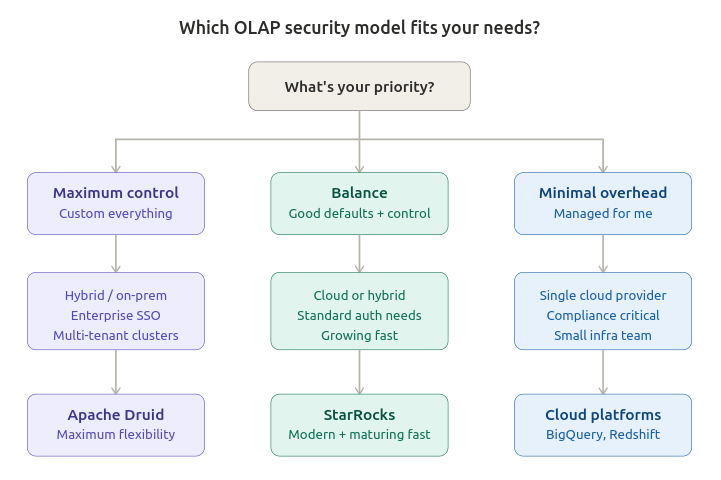
Druid offers the most security flexibility – ideal for hybrid or on-prem environments with complex SSO requirements. StarRocks provides solid, developer-friendly security defaults that are maturing fast. Cloud platforms win on automation and compliance, but lock you in. Your choice depends on whether you prioritize control or convenience.
At Deep.BI, we process billions of real-time events for our clients. Speed matters – but so does security.
We've deployed both Apache Druid and StarRocks at scale, and we regularly field questions from engineering teams trying to decide between them. Performance and cost usually dominate those conversations, but security often becomes the deciding factor – especially for organizations in regulated industries or handling sensitive user data.
We wanted to answer a practical question: if security and compliance matter to your team, which platform makes your life easier – and which creates more work?
This article shares what we learned. For context, we also compared both platforms against cloud-native solutions like BigQuery and Redshift, since many teams are weighing self-managed open source against fully managed alternatives.
Druid offers the most knobs to turn. It supports basic auth, LDAP, Kerberos, and custom authentication plugins – which matters if you're operating in a hybrid or on-prem environment where you can't just lean on a cloud provider's identity layer.
We've found Druid's LDAP and Kerberos integration particularly useful for plugging into enterprise SSO setups. If your organization has strict identity requirements, Druid will meet you where you are.
StarRocks takes a simpler approach with MySQL-style authentication, plus LDAP and Kerberos support. It's the least complex to get running, which is either a strength or a limitation depending on your environment. For teams without elaborate identity infrastructure, this simplicity is a feature.
Cloud platforms offload most identity work to IAM. It's less flexible, but simpler to operate day-to-day.
Our take: If you need to integrate with complex enterprise identity systems, Druid's flexibility is hard to beat. If you want something that just works out of the box, StarRocks gets you there faster.
All platforms offer role-based access control, but the depth and philosophy differ significantly.
Druid's RBAC is the most customizable. You can define granular permissions across datasources and APIs, which is essential if you're running multi-tenant analytics clusters where different teams or clients need carefully scoped access. The trade-off: it's more manual work to set up and maintain. (If you're going with Druid, our step-by-step RBAC guide walks through the configuration.)
StarRocks offers multi-level permission granularity that's intuitive enough for most teams without requiring you to learn an entire IAM policy language. For engineering teams that want solid access controls without a dedicated governance function to manage them, it hits a practical sweet spot.
Cloud platforms integrate authorization into their broader IAM frameworks. This makes policy enforcement more consistent across your entire stack – not just your OLAP layer.
Our take: Druid's authorization model requires more upfront investment, but pays off in complex, multi-tenant environments. StarRocks strikes a balance that works well for most engineering teams.
This is where cloud platforms pull ahead most clearly.
BigQuery, Redshift, and managed ClickHouse offerings all provide automated encryption at rest via KMS or customer-managed keys, with TLS enforced in transit. Key rotation and compliance reporting are handled for you.
Druid supports TLS/SSL and standard encryption mechanisms, but you're managing the keys and configuration yourself. That's fine if you have the infrastructure team for it, but it's one more operational burden to own.
StarRocks is actively rolling out Transparent Data Encryption (TDE), which is encouraging. It's not fully mature yet, but it signals the project is taking compliance seriously – and it's improving with each release.
Our take: If you're in a regulated industry or facing strict compliance audits, cloud-native encryption is significantly less painful. For self-managed infrastructure, Druid and StarRocks both require you to own the encryption story — but StarRocks is closing the gap.
We expected cloud platforms to dominate here, and they do offer polished, centralized logging that integrates neatly with their monitoring ecosystems. For compliance-driven organizations, it's close to zero-effort.
But StarRocks' auditing capabilities are genuinely impressive for a project at its maturity level. Fine-grained, real-time audit trails with IP and user-level visibility – that's the kind ofoperational transparency that's useful beyond just checking compliance boxes. It helps you understand what's actually happening in your cluster right now.
Druid's audit logging is solid and was easy to pipe into our existing monitoring setup. No complaints, but nothing that surprised us either.
Our take: All three approaches meet baseline compliance needs. But StarRocks' real-time audit trails stood out for operational transparency – valuable for fast-moving analytics teams who want visibility into cluster activity beyond what compliance requires.
Druid gives you full control – TLS between components, VPN integration, firewall rules. If you want to design your network topology yourself, it doesn't get in your way. That's powerful for on-prem deployments, but it also means every security decision is yours to make (and yours to get wrong).
Cloud platforms default to managed VPCs, inter-node encryption, and IAM-scoped access. The security posture out of the box is strong, and you'd have to actively misconfigure things to weaken it.
StarRocks sits in between. It supports VPC integration, IP whitelisting, and TLS, giving you cloud-like isolation without locking you into a specific provider.
Our take: Druid gives power users the keys to the network. Cloud platforms minimize human error through pre-configured isolation. StarRocks offers a practical middle path for teams that want reasonable defaults without full cloud lock-in.
Security management isn't about finding a one-size-fits-all system. It's about aligning your data platform's security model with your team's operational reality.
At Deep.BI, we've deployed both Druid and StarRocks in environments where security was non-negotiable. The right choice depends on your deployment model, your compliance requirements, and honestly – the size and expertise of your infrastructure team.
If you're still weighing the options, we're happy to help.
We've deployed both Druid and StarRocks at scale for clients across industries. Whether you're migrating from a legacy system, hardening an existing deployment, or starting fresh, our team can help you make the right architectural decisions.


